























Tomato Crisis Exposes ‘Policy Failure’ — FABAG Slams Govt Over Import Dependence
The Food and Beverages Association Ghana (FABAG) has expressed strong concern over the ongoing tomato supply crisis, following Burkina Faso’s ban on tomato exports to Ghana. In a press release, FABAG described the situation as a clear indication of weaknesses, poor planning, and policy failures within Ghana’s agricultural sector. The association said Ghana’s continued reliance […]

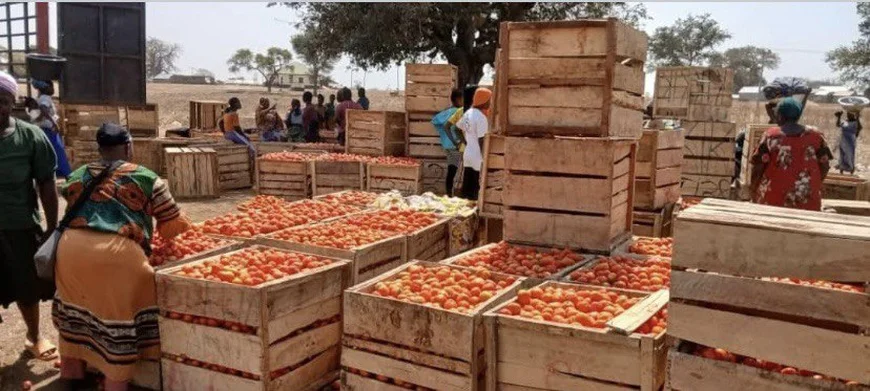
The Food and Beverages Association Ghana (FABAG) has expressed strong concern over the ongoing tomato supply crisis, following Burkina Faso’s ban on tomato exports to Ghana.
In a press release, FABAG described the situation as a clear indication of weaknesses, poor planning, and policy failures within Ghana’s agricultural sector.
The association said Ghana’s continued reliance on imports for a basic commodity like tomatoes is unacceptable, despite the country’s vast agricultural resources.
“This situation has once again exposed the dangerous weakness, poor planning, and policy failure within Ghana’s agricultural sector. It is completely unacceptable that a country with vast agricultural land, irrigation dams, agricultural colleges, research institutions, extension officers, and a full Ministry of Food and Agriculture cannot produce enough tomatoes to feed its own population and must depend on another country for such a basic food commodity,” the statement said.
FABAG added that if the Ministry of Food and Agriculture is unable to coordinate nationwide tomato production within the next two to three months, the government should consider restructuring it into a more production-focused institution with clear targets and accountability.
“FABAG wishes to state clearly and without apology that if the Ministry of Food and Agriculture cannot mobilise the country to produce tomatoes within two to three months, then the Ministry has failed in its core mandate and has no justification to continue to exist in its current form.”
The association argued that tomatoes are a short-cycle crop that can be cultivated and harvested within 60 to 90 days, stressing that with proper planning and irrigation, Ghana could produce the commodity multiple times a year.
It maintained that the country has the capacity to address the current shortage within a short period if the right measures are implemented.
FABAG further noted that Ghana has fertile land, irrigation infrastructure, research institutions, extension officers, and access to inputs such as improved seeds, fertilisers, and mechanisation services, yet continues to face production challenges. According to the Association, this points to issues of leadership and policy direction rather than a lack of resources.
The group warned that reliance on other countries for essential food items poses a national security risk and urged the government to take urgent steps to boost local production.
As part of its recommendations, FABAG called for the declaration of a national emergency tomato programme, the distribution of improved seeds, the provision of subsidised inputs, the activation of irrigation systems, and the mobilisation of youth into commercial tomato farming. It also proposed support for greenhouse production, revival of tomato processing factories, and investment in storage and transportation to reduce post-harvest losses.
The Association further urged the government to set a target for Ghana to achieve tomato self-sufficiency within one year, stressing the need to shift from policy discussions to practical results in food production.
Read the statement by FABAG below:
…. 24 March, 2026
PRESS RELEASE
THE MINISTRY OF FOOD AND AGRICULTURE HAS NO JUSTIFICATION TO EXIST IF GHANA CANNOT PRODUCE TOMATOES WITHIN 60-90 DAYS.
The Food and Beverages Association Ghana (FABAG) wishes to express its strongest concern and disappointment at the unfolding tomato supply crisis in Ghana following the ban on tomato exports from Burkina Faso. This situation has once again exposed the dangerous weakness, poor planning, and policy failure within Ghana’s agricultural sector.
It is completely unacceptable that a country with vast agricultural land, irrigation dams, agricultural colleges, research institutions, extension officers, and a full ministry of food and agriculture cannot produce enough tomatoes to feed its own population and must depend on another country for such a basic food commodity.
FABAG wishes to state clearly and without apology that if the Ministry of Food and Agriculture cannot mobilise the country to produce tomatoes within two to three months, then the ministry has failed in its core mandate and has no justification to continue to exist in its current form.
This is not politics or emotions! This is national food security.
It is an agricultural fact, not theory, that tomatoes can be produced within two (2) to three (3) months and, for that matter, can be produced about three (3) times a year. As a matter of fact, tomatoes are a short-cycle crop. With irrigation and proper seed varieties, tomatoes begin harvesting within 60 to 90 days after planting. This means that if the ministry were proactive and results-orientated, Ghana could immediately launch a national emergency tomato programme and begin harvesting within three months.
Therefore, any claim that Ghana cannot solve tomato shortages quickly is simply an admission of policy failure, planning failure, and leadership failure.
Ghana has :
- Fertile land
- Irrigation dams (Vea, Tono, Botanga, Kpong, Dawhenya, Ashiama, and others)
- Farmers are already producing tomatoes, so it’s not something we are going to learn new.
- Thousands of unemployed youth who can be mobilised into farming
- Launched 24-hour economy in all sectors of production in Ghana
- Agricultural universities and research institutions
- Extension officers in every district
- Access to improved seeds
- Access to fertiliser
- Access to pesticides
- Access to tractors and mechanisation centres
If after all these resources Ghana still cannot produce tomatoes to feed its people, then the problem is not farmers, land or climate; the problem is leadership and policy direction.
Depending on another country for a basic food item like tomatoes is not just an agricultural issue but also a national security risk. Today, it is tomatoes; tomorrow it may be something else. Economic security is national security!
The Food and Beverages Association of Ghana is calling for immediate emergency measures:
- Declare a National Tomato Emergency Programme
- Distribute improved tomato seeds nationwide within 2 weeks
- Provide subsidised fertiliser and agrochemicals
- Activate all irrigation schemes for dry season tomato farming
- Mobilise youth groups for commercial tomato farming
- Provide a guaranteed price for tomato farmers
- Support greenhouse tomato production
- Revive tomato processing factories
- Provide cold trucks and storage facilities to reduce post-harvest losses
- Set a target for Ghana to become tomato self-sufficient within one year.
- Ghana travel guide
The time has come for Ghana to move from policy speeches to food production results.
Ghana cannot continue to have the following:
- A Ministry of Food and Agriculture
- Agricultural universities
- Research Institutions
- Irrigation dams
- Extension officers
- Subsidy programmes
And still import tomatoes or depend on Burkina Faso to feed us.
This is not acceptable!
If within two to three months the ministry cannot organise tomato production under irrigation across the country, then the government must seriously consider restructuring the ministry into a production-focused agricultural authority with clear targets and accountability.
The time for excuses is over! The time for production is now! Time for a 24-hour secretariat and policy to justify its true relevance!
Signed
Rev. John Awuni
Chairman, FABAG
Click the link Puretvonline.com | WhatsApp Channel to join the WhatsApp channel
GOT A STORY?
Contact/WhatsApp: +233243201960 or manuelnkansah33@gmail.com