

AI Is Now A Weapon-MTN Ghana Chief Information Officer

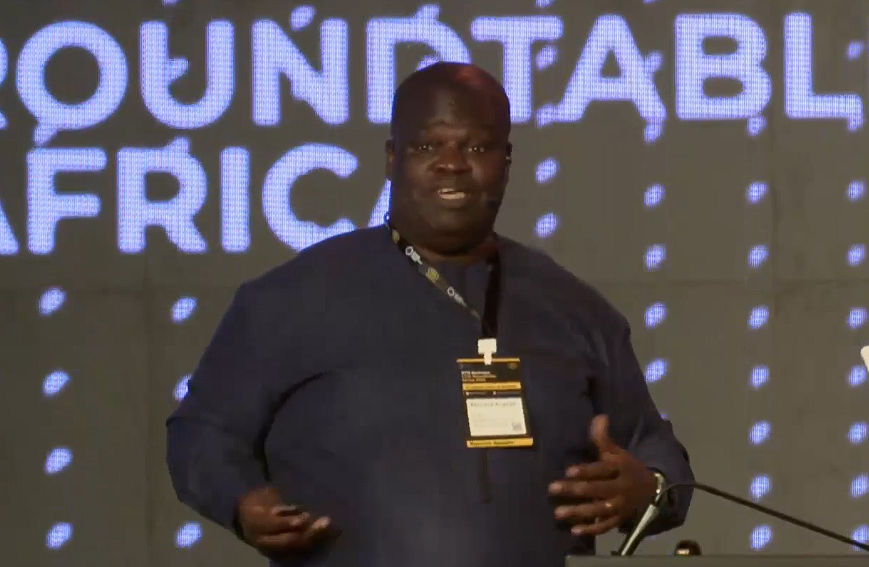
Artificial intelligence is no longer just a productivity tool; it is now a cybersecurity weapon, and organisations that fail to adapt are already exposed. Chief Information Officer of MTN Ghana, Bernard Acquah, has warned in a hard-hitting address that placed AI-driven security threats at the centre of enterprise risk.
Speaking at the 4th Annual CTIO Roundtable Africa 2026 at the Labadi Beach Hotel in Accra, Mr Acquah cautioned that the same technology transforming business efficiency is rapidly becoming a powerful tool for cybercriminals, capable of infiltrating systems in ways traditional defences were never designed to handle.
AI, he said, is a “horizontal technology”, one that cuts across every industry, system, and process, making its security implications far broader and more dangerous than previous waves of digital innovation.
“AI is shaping every sector. We are at the cusp of a revolution across everything we do in business, commerce, and daily life,” he noted, warning that its influence is now comparable to historic shifts such as electricity and the internet.
But the real alarm, he stressed, lies in how AI is being weaponised.
Mr Acquah revealed that cybersecurity threats are evolving beyond traditional hacking and firewall breaches, with AI now being used to penetrate internal systems, including software development pipelines.
“In the last few weeks, we’ve seen a big growth in cybersecurity incidents related to AI. AI is being used almost like a Trojan horse to infect internal development teams and products,” he said.
This shift, he warned, means attackers no longer need to break through perimeter defences; they can now infiltrate organisations through trusted tools, code assistants, and internal AI systems.
For CIOs and CISOs, this marks a fundamental rethink of enterprise security strategy.
Mr Acquah pointed to emerging global efforts to use artificial intelligence as a defensive weapon against itself, referencing industry-wide movements where AI is being deployed to detect and neutralise AI-generated attacks.
He cited advanced research efforts such as Anthropic’s internal security experiments and collaborative projects involving major tech players, which are focused on identifying vulnerabilities exposed by powerful AI systems.
“These new models are so sophisticated they are finding vulnerabilities in software everyone believed was secure,” he said.
In some cases, he noted, the capability of advanced models has raised enough concern that developers have hesitated to release them widely due to the potential misuse of their security-discovery capabilities.
“This is the reality: AI can be used to attack you, so AI must also be used to defend you,” he warned.
Mr Acquah stressed that organisations must abandon outdated assumptions about cybersecurity and move toward AI-native defence systems built on continuous monitoring, explainability, and adaptive response.
He outlined key principles for securing AI-driven environments:
- Human accountability remains non-negotiable: “AI does not remove responsibility. Leaders are still accountable for every outcome.”
- Explainability is critical: organisations must understand how AI systems reach decisions in order to detect manipulation or failure.
- Workforce readiness is a security issue: employees must be trained to identify when AI outputs are wrong or compromised.
- Disciplined experimentation is essential: innovation must be balanced with controlled risk exposure.
One of the strongest warnings from the MTN Ghana CIO centred on over-reliance on AI systems without oversight.
He cautioned that professionals who lack domain expertise risk blindly trusting AI-generated outputs, creating dangerous blind spots in decision-making and security operations.
“If you are not skilled, you will believe everything the system tells you. That is where the danger begins,” he said.
Mr Acquah also highlighted the rise of agentic AI systems capable of executing tasks autonomously as a new frontier of cybersecurity exposure.
As organisations shift from basic AI tools to semi-autonomous agents, he warned that attack surfaces will expand significantly, requiring stronger governance and real-time control mechanisms.
The MTN Ghana CIO’s message was direct: cybersecurity is no longer a support function; it is now a core battlefield in the AI era.
With AI systems accelerating in capability every few months, he warned that attackers and defenders are now locked in a rapidly evolving technological arms race.
“The tool is neutral. But in the wrong hands, it is dangerous. And in the right hands, it must be carefully controlled,” he said.
