

DOCUMENTS: GH¢70m Digital Youth Village, ICT Programme Costs Emerge in MoCDTI Budget Extract

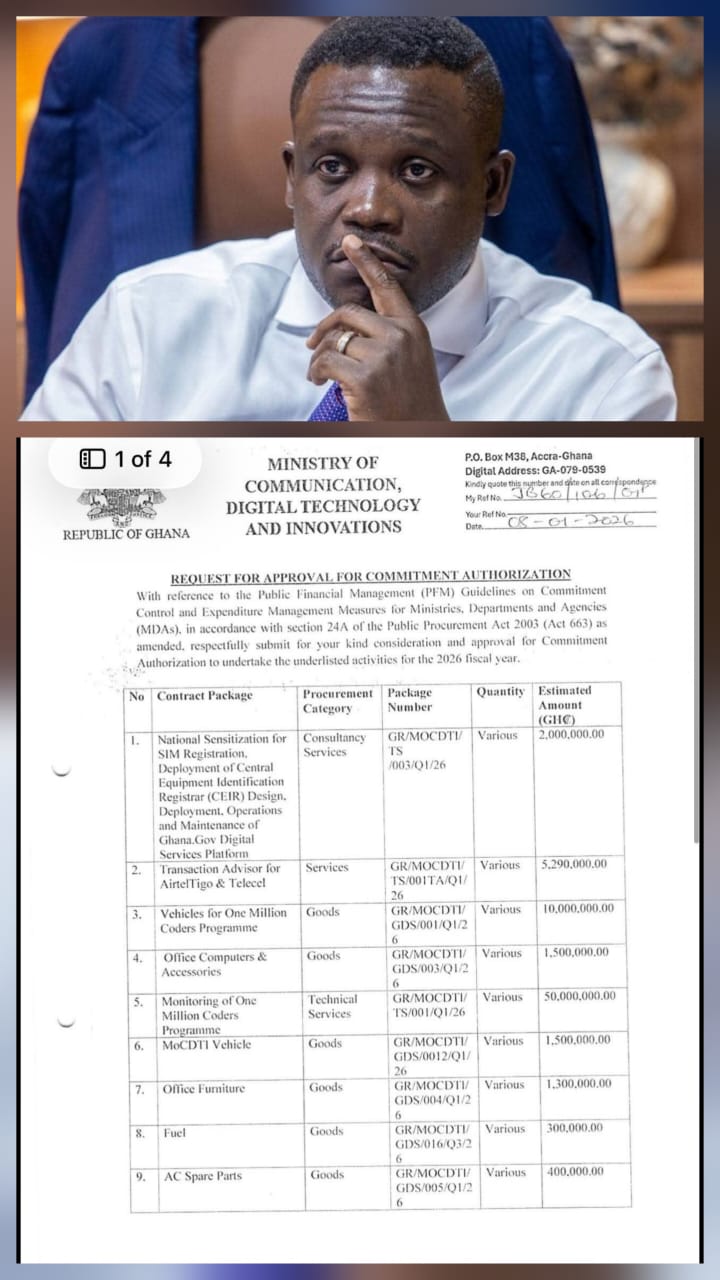
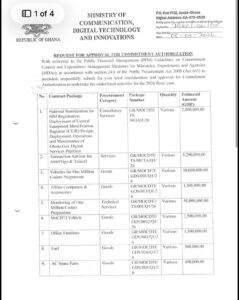
A detailed government document outlining planned expenditures under the Ministry of Communication, Digital Technology and Innovations (MoCDTI) for the 2026 fiscal year has drawn public attention, following social media discussions about its contents and interpretations.
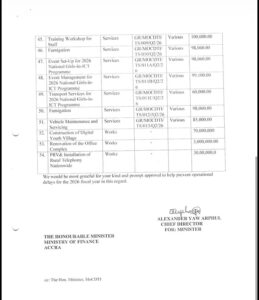
The document, structured as a procurement and commitment authorisation request, lists a series of programme, service, and works packages intended to support flagship digital inclusion initiatives, including the 2026 National Girls-in-ICT Programme and broader digital infrastructure development projects.
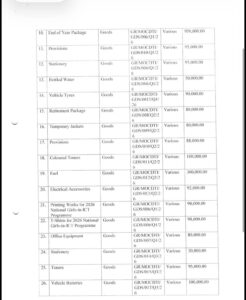
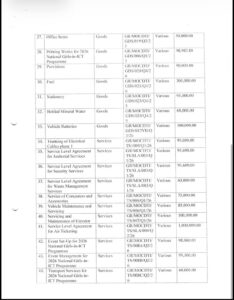
At the centre of the breakdown is a set of line items covering event organisation, logistics, training, sanitation, and infrastructure works, with individual allocations ranging from under GH¢100,000 to multi-million-cedi capital investments.
For the Girls-in-ICT Programme alone, several related service packages appear repeatedly across different phases of implementation. These include:
- Event management services valued at approximately GH¢98,060 and GH¢99,100 under separate package codes
- Event set-up and logistics support are also priced around GH¢98,060
- Transport services for participants and operations estimated at GH¢60,000 and other related allocations.
- Training workshops for staff, pegged at GH¢100,000
- Fumigation services, appearing in multiple entries at about GH¢98,060 per package.
- Vehicle maintenance and servicing, estimated at GH¢85,000
These recurring entries suggest a multi-layered operational structure for the programme, potentially spanning regional activities, multiple event cycles, and decentralised implementation phases throughout the year.
Beyond the Girls-in-ICT programme, the document also highlights significantly larger infrastructure investments classified under “Works”.
The most substantial item is the proposed construction of a digital youth village, estimated at GH¢70 million, signalling a major capital project aimed at expanding digital skills training and youth engagement infrastructure.
Other high-value infrastructure allocations include:
- GH¢30 million for PRV and installation of rural telephony nationwide
- GH¢3 million for the renovation of the ministry’s office complex
These projects, if approved, would form part of a broader national push to expand digital access, improve institutional capacity, and extend telecommunications infrastructure to underserved areas.
According to the covering correspondence attached to the document, the request was submitted for commitment authorisation to the Ministry of Finance, a procedural step required before any expenditure can be executed under Ghana’s public financial management framework. The submission was signed by the chief director, Alexander Yaw Arphul, and addressed to the minister for finance in Accra, with copies to the sector minister.
The Ministry of Communication, Digital Technology and Innovations has since clarified that the document has been widely misinterpreted in public discussions.
It explained that the extract being circulated represents only a segment of a larger budgetary submission and not evidence of actual expenditure. The ministry stressed that no funds have been released or disbursed and that the request remains subject to approval by the Ministry of Finance.
Officials further indicated that such submissions form part of standard government procurement and budgeting processes tied to approved parliamentary allocations for the 2026 fiscal year.
The Ministry also reaffirmed that all listed activities are planned interventions intended to support policy objectives in digital inclusion, skills development, and rural connectivity expansion.
The document itself reflects a typical pre-approval stage in public sector financial planning, where ministries outline anticipated service requirements and infrastructure needs ahead of final budget execution.
In this case, the listed items span both recurrent operational costs such as event management, logistics, and training and long-term capital investments aimed at expanding Ghana’s digital infrastructure footprint.
Government finance procedures require that such commitments receive authorisation before procurement or disbursement can proceed, ensuring alignment with budget ceilings and national fiscal controls.
While the Ministry has urged the public to disregard claims of misappropriation, the emergence of the document has nevertheless reignited broader public interest in how digital sector budgets are structured and communicated.
Click the link Puretvonline.com | WhatsApp Channel to join the WhatsApp channel
GOT A STORY?
Contact/WhatsApp: +233243201960 or manuelnkansah33@gmail.com
