


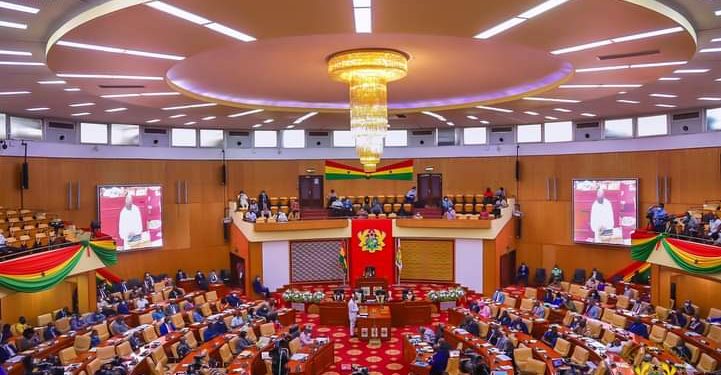
The Majority in Parliament has dismissed claims by the Minority that the Bank of Ghana sold a significant portion of its gold reserves to conceal financial distress, insisting instead that the central bank’s GH¢9.57 billion gain from gold transactions in 2025 reflects legitimate reserve management.
The minority had argued that the Bank of Ghana (BoG) is “policy insolvent”, insisting that the central bank can no longer sustain its core monetary operations without resorting to extraordinary measures.
But in a statement issued on Sunday, May 3, 2026, Atta Issah, the Member of Parliament for Sagnarigu and a member of the Finance Committee, rejected that interpretation, accusing the minority of misreading technical financial data and drawing conclusions that risk misleading the public.
“The characterisation of the GH¢9.6 billion as a falsehood simply because it arises from gold transactions is misleading,” the majority said in its statement.
The caucus argued that gold transactions form part of standard central bank operations, noting that reserve management typically involves rebalancing holdings between gold, foreign currency, and other financial instruments to enhance liquidity, safety, and returns.
“Gains from such portfolio management are legitimate income. They are not fake because they are not recurring every year. Non-recurring does not mean illegitimate,” the statement added.
The Minority had maintained that stripping out the one-off gold gain would leave the Bank of Ghana with an operational deficit of about GH¢4 billion, which it described as evidence of “policy insolvency”. It further alleged that the bank had rushed to sell 50 per cent of its gold reserves to artificially shore up its financial position.
However, the majority firmly rejected the assertion that the transaction reflected distress.
“Central banks are not commercial institutions. Policy solvency is not determined by a single year’s operating income minus expenses. It depends on the overall balance sheet, including reserves, revaluation buffers, and sovereign backing,” the caucus stated.
It also dismissed suggestions of a forced liquidation of gold holdings.
“The audited statements do not show any distress liquidation. What they show is a measured portfolio adjustment,” the majority stressed.
The statement further noted that Ghana has, in recent years, pursued policies aimed at increasing its gold reserves through domestic purchase programmes, arguing that this trend is inconsistent with claims of depletion driven by financial weakness.
According to the majority, the conversion of part of the bank’s gold holdings into liquidity should instead be viewed within the broader context of macroeconomic pressures, including debt restructuring, exchange rate volatility and tightening global financial conditions.
“This is not evidence of collapse. It is evidence of management under pressure,” the statement concluded.
Click the link Puretvonline.com | WhatsApp Channel to join the WhatsApp channel
GOT A STORY?
Contact/WhatsApp: +233243201960 or manuelnkansah33@gmail.com
