


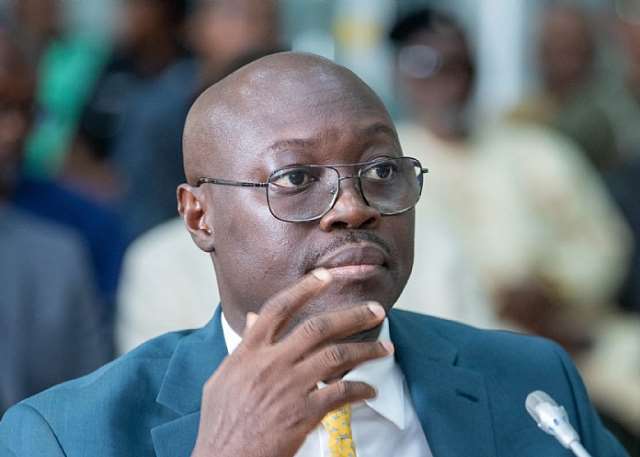
Ghana is facing a deepening fiscal crisis, with the government borrowing about GH¢17 billion solely to meet public sector wage obligations, Finance Minister Dr Cassiel Ato Forson has revealed.
The development effectively shuts the door on new public sector employment and severely constrains development spending.
Speaking at the Presidency, Dr Forson presented stark fiscal data showing that while total tax revenue reached GH¢183 billion in 2025, statutory obligations, including transfers to the District Assemblies Common Fund (DACF), Ghana Education Trust Fund (GETFund), the National Health Insurance Levy (NHIL), and debt servicing, absorbed GH¢122.1 billion, leaving only GH¢61.9 billion available.
However, the public sector wage bill alone stood at GH¢78.9 billion, creating a financing gap of GH¢17 billion, which had to be borrowed just to pay salaries.
The figures reveal that 44% of tax revenue goes into wages, far above the 35% ECOWAS ceiling, while debt servicing consumes 26% and statutory transfers take 24%. Together, these obligations consume 83% of total revenue, leaving minimal allocations for other expenditures: capital projects receive just 6%, goods and services 3%, social benefits 1%, and other spending 7%.
“This structure leaves the government with virtually no fiscal space, forcing it to borrow not only for development but even for routine obligations,” Dr Forson said.
The wage-driven borrowing effectively freezes public sector hiring, raising questions about promises to expand recruitment in security services from 20,000 to 40,000 personnel over the next four years. Analysts warn that expanding employment under current conditions is financially unsustainable.
Capital expenditure constraints also jeopardise infrastructure development, with roads, schools, hospitals, and other projects facing severe underfunding. Economists caution that borrowing to pay wages, a form of consumption financing, adds to Ghana’s debt burden without generating economic returns, potentially crowding out investment and slowing growth.
Historical data underscores the long-standing nature of the problem. Public sector wages have consistently consumed a large share of tax revenue over the past decade:
- 2016: GH¢14.2B out of GH¢25.7B (55%)
- 2017: GH¢16.8B of GH¢32.2B (52%)
- 2018: GH¢19.6B of GH¢37.8B (51.9%)
- 2019: GH¢22.2B of GH¢42.8B (51%)
- 2020: GH¢28.3B of GH¢44.4B (63.6%)
- 2021: GH¢31.7B of GH¢56.5B (31.7%)
- 2022: GH¢39.4B of GH¢75.5B (52.2%)
- 2023: GH¢50.8B of GH¢110B (46.2%)
- 2025: GH¢67.2B of GH¢151.2B (44.5%)
Even as revenue grows, wage expenditure continues to absorb a large proportion, limiting fiscal flexibility and underscoring a structural imbalance.
The fiscal reality casts doubt on government commitments to create public sector jobs and implement labour-intensive policies, including the proposed 24-hour economy model.
Dr Forson has emphasised the urgent need for reforms to restore fiscal balance, including managing wage growth, improving revenue mobilisation, and rationalising expenditure to create room for employment and development.
Without decisive action, Ghana risks entrenching a cycle where borrowing to pay salaries becomes routine, crowding out investment, slowing economic growth, and limiting opportunities for future generations.
Click the link Puretvonline.com | WhatsApp Channel to join the WhatsApp channel
GOT A STORY?
Contact/WhatsApp: +233243201960 or manuelnkansah33@gmail.com
