


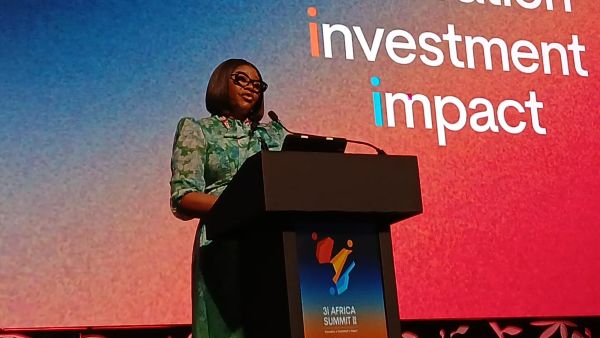
Africa’s ability to attract long-term investment into its digital economy will depend less on innovation headlines and more on whether countries can build trusted, harmonised and interoperable financial systems, Second Deputy Governor of the Bank of Ghana Matilda Asante-Asiedu has said.
Speaking at the 3i Africa Summit 2026 in Accra, Madam Asante-Asiedu stressed that while data and digital innovation are increasingly central to Africa’s financial transformation, capital ultimately flows to markets where systems work, rules are predictable, and trust is established.
“Capital is what it is capital. It flows where systems work, where payment rules are reliable, where regulatory frameworks are clear and where trust exists,” she said.
She cautioned that attracting investment into Africa’s digital economy requires more than policy ambition, stressing the need for a strong underlying architecture that supports innovation at scale.
According to her, this includes trusted payment systems, robust digital public infrastructure such as identity frameworks, strong consumer protection regimes, and coordinated regulatory systems that enable cross-border expansion.
“Without the right architecture, innovation cannot translate into investment or inclusion,” she noted.
Madam Asante-Asiedu said the real test for policymakers lies in bridging the gap between well-designed policies and functioning systems that enable everyday financial transactions for ordinary people.
She warned that failure in this transition results in exclusion, while success creates broad-based economic participation.
“The distance between policy design and a functioning system is where we either succeed or fail,” she said.
She outlined three key priorities for strengthening Africa’s digital financial ecosystem:
1. Build real infrastructure, not just frameworks.
She said governments must focus on implementing tangible digital infrastructure rather than producing policy documents that do not translate into inclusion outcomes.
2. Harmonise systems for seamless cross-border trade
As Africa advances digital trade protocols and financial passporting initiatives, she calls for stronger coordination to ensure systems are interoperable and frictionless.
“Nothing is more frustrating than starting a transaction and not being able to complete it across systems,” she said.
3. Keep inclusion at the centre of digital growth
She warned that digitisation that benefits only those already within the system amounts to “digitising advantage, not inclusion”.
Instead, she stressed that financial inclusion must remain the core objective of digital transformation.
Madam Asante-Asiedu also highlighted that Ghana’s mobile money experience has demonstrated that financial inclusion is not only socially important but also commercially viable.
She argued that well-designed inclusive systems can attract capital more effectively because they expand the market base and build trust.
“Inclusion is also profitable,” she said.
She said the effectiveness of Africa’s digital financial systems should ultimately be measured by how well they serve market traders, small businesses, rural communities, farmers and women-led enterprises.
“Inclusion is achieved when access becomes broader, more trusted and more useful,” she noted.
Concluding her remarks, the Deputy Governor said Africa has already proven its ability to innovate and lead in digital finance, but the next phase will require stronger, more connected systems across the continent.
“We have shown we can innovate with what we have. The next stage will require solid architecture that connects us across countries,” she said.
