


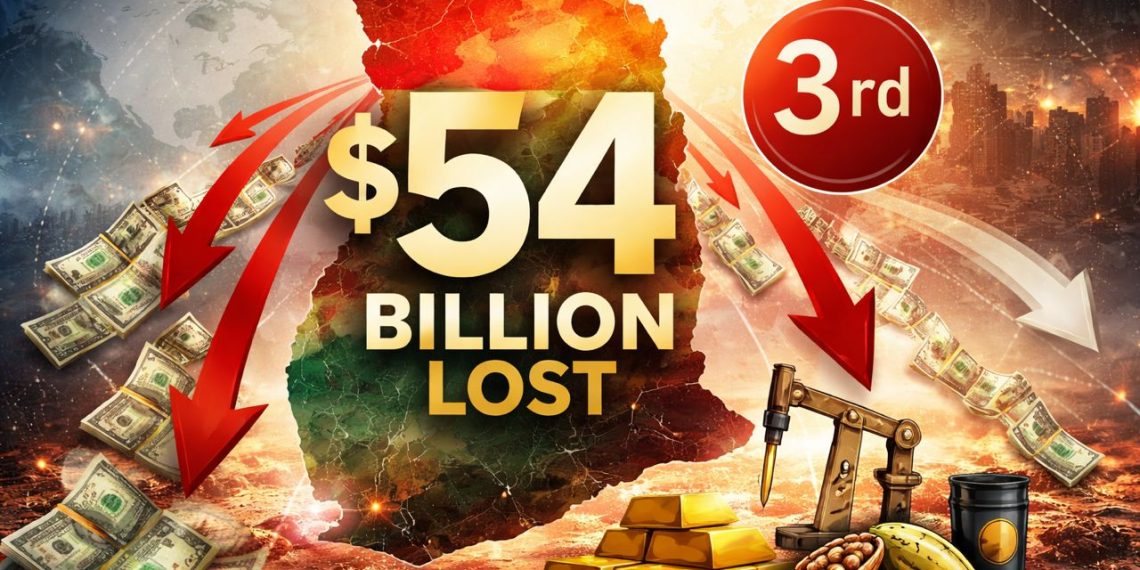
Ghana lost an estimated US$54.1 billion to trade-related illicit financial flows between 2013 and 2022, placing it third among Africa’s top-10 affected countries.
According to a new Global Financial Integrity (GFI) report, “Trade-Related Illicit Financial Flows in Africa, 2013–2022”, the findings highlight structural vulnerabilities in the country’s trade with international partners.
Using data which compares what countries report as exports against what their trading partners record as imports, the GFI found that nearly 28% of Ghana’s trade may be misinvoiced, mispriced, or unaccounted for. This equates to almost $3 out of every $10 in international trade involving Ghana.
While larger economies like South Africa ($478 billion) and Nigeria ($77.7 billion) lead in absolute losses, Ghana surpasses regional peers such as Côte d’Ivoire ($47.7 billion) and Kenya ($47.5 billion).
The report links these high figures to the opacity of Ghana’s major export sectors, like gold, cocoa, and oil, where pricing irregularities and power imbalances with multinational buyers facilitate under-invoicing.
Trade with developed nations, including the G7, accounted for $20.5 billion in losses over the decade—roughly 25% of Ghana’s trade with advanced economies, suggesting a substantial outflow of wealth from natural resources to the Global North.
The human impact is significant. Countries with high IFFs spend on average 25% less on health and 58% less on education than their peers.
For Ghana, even partially reclaiming the $54.1 billion could fund schools, clinics, and critical infrastructure currently under-resourced.
To address the massive outflows, the report recommends that Ghana modernise its customs systems by implementing advanced data analytics and risk-based inspections to flag suspicious transactions in real time.
It also calls for the establishment of comprehensive beneficial ownership registries to reveal the true owners of companies and trusts, making it harder for shell entities to hide illicit gains.
GFI encourages the use of blockchain technology or similar tools to enable the automatic exchange of trade valuation data, closing information gaps between trading partners.
Strengthening regional cooperation is also highlighted, with the African Continental Free Trade Area (AfCFTA) seen as a key mechanism to harmonise trade invoice verification across borders and detect discrepancies.
Finally, the report stresses the need for robust legal enforcement, urging governments to criminalise trade misinvoicing, impose meaningful penalties, and protect whistleblowers who expose tax evasion.
GFI warns that without decisive action, Ghana’s economic sovereignty and inclusive growth goals remain at risk.
Effective reforms could transform the country from a net exporter of illicit outflows into one that harnesses its wealth for domestic development.
Click the link Puretvonline.com | WhatsApp Channel to join the WhatsApp channel
GOT A STORY?
Contact/WhatsApp: +233243201960 or manuelnkansah33@gmail.com
