

Sam George Unveils Bold Move to Stop Wastage in IT Procurement Across Government

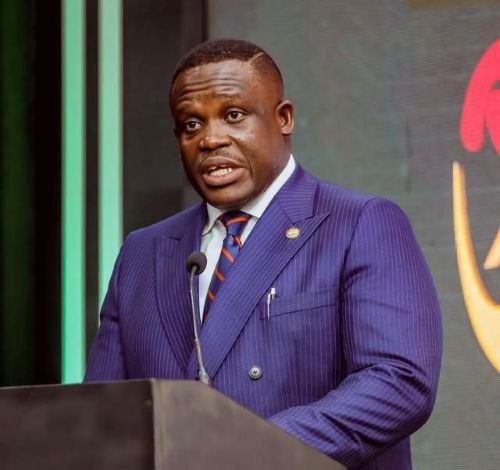
The Minister for Communication, Digital Technology and Innovation, Hon. Samuel Nartey George, has announced a decisive move to stop wastage in the system that comes through IT procurement across government institutions, describing the abuse of ICT contracts as one of the biggest drains on the public purse.
Speaking to the Vice President Prof. Jane Naana Opoku Agyemang on her maiden visit to the ministry, the minister revealed that investigations into how things were done in the past eight years exposed widespread duplication of ICT contracts, with the same service providers offering identical solutions to multiple government agencies and receiving payment multiple times for the same system.
“One of the biggest challenges we’ve seen is wastage in the dispensing of public funds,” Hon. Samuel George said. “A lot of people use IT as a way to rip off the public purse.”
He explained that in several cases, a single service provider delivered the same ICT solution to as many as five government agencies, signing similar contracts repeatedly and receiving payment five times, a practice he stressed is not permitted under existing law.
To address the problem, the Minister disclosed that his Ministry has formally written to the Public Procurement Authority (PPA), copying the Minister for Finance, to enforce a new commitment authorisation policy.
Under the new framework:
- The PPA will not approve any ICT-related government contract without commitment authorisation from the Ministry of Finance.
- All government ICT procurements must receive prior approval from the National Information Technology Agency (NITA), in line with provisions of the Electronic Transactions Act.
- NITA will maintain an overview of government ICT assets to prevent the state from paying twice for the same system.
“If an agency wants to procure a system we’ve already paid for elsewhere, we will simply leverage it instead of paying for it again,” he said.
Hon. Samuel George cited a recent case involving the Ghana Revenue Authority’s proposed acquisition of an AI system known as Publica. Following NITA’s technical assessment, conditional approval was granted after it was discovered that sensitive trade data was initially going to be hosted outside Ghana.
“That was critical national security information,” he noted. “Because the process came to NITA, safeguards were inserted to protect the state.”
He referenced past challenges in the health sector, where national data was handled by private service providers, as a lesson reinforcing the need for stronger oversight.
The minister assured agencies that the new process is not intended to delay procurement.
“In less than five working days, we will complete technical assessments and approve where necessary,” he said. “If the system already exists, we will leverage it to save the public purse.”
He also confirmed that the Office of the President has banned new biometric software acquisitions, following revelations of excessive and unnecessary duplication, warning that similar risks now exist with the rush to procure artificial intelligence solutions.
Beyond procurement reforms, Hon. Samuel George highlighted major gains at Ghana Post, including a partnership with the Ministry of Foreign Affairs that enabled the delivery of over 100,000 biometric passports in under six months, significantly reducing public complaints.
He also outlined plans to transform Ghana Post into a financial services hub to support financial inclusion, particularly in communities without banks, in collaboration with the Bank of Ghana.
The minister further raised concerns about the .GH domain, Ghana’s national digital identity, which has historically been managed outside formal state control. He announced plans to transition the .GH domain root server fully to state custody and urged government support to promote the use of .com.gh domains among Ghanaian businesses.
“When a company uses a .com domain, it appears as an American business online,” he explained. “The .gh domain is what shows our Ghanaian identity on the internet.”
Hon. Samuel Nartey George emphasised that the reforms are aimed at protecting public funds, securing national data, and ensuring efficiency in government digital transformation.
“This is about accountability, national security and value for money,” he said. “We are determined to stop wastage and build a smarter, safer digital government.”
Click the link Puretvonline.com | WhatsApp Channel to join the WhatsApp channel
GOT A STORY?
Contact/WhatsApp: +233243201960 or manuelnkansah33@gmail.com
