

KPMG Unveils Tightened, Integrity-Driven Process for 5th Ghana Fintech Awards


Manager of Technology Advisory at KPMG, Ezekiel Akpan, delivered a commanding address at the launch of the 5th Ghana Fintech Awards at the Nobel International Business School, outlining a more rigorous, data-driven, and integrity-focused awards process designed to match the rapid expansion of Africa’s digital payments landscape.
Akpan opened with staggering industry figures, reminding stakeholders that fintech has become the backbone of Africa’s day-to-day transactions.
“In 2024 alone, Africa recorded 49 billion transactions valued at $1.3 trillion, spanning more than 28 countries,” he said. “Someone buys produce on a farm, someone pays at a shop, someone settles a facility—the digital rails run everywhere. That’s the market we are building for.”
It is this explosive growth, he said, that makes the Ghana Fintech Awards more critical each year—both as a benchmark for excellence and as a mechanism for strengthening compliance and resilience across the sector.
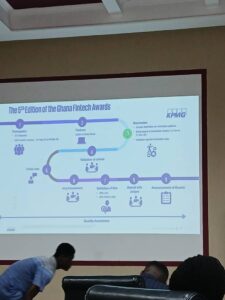
Akpan walked industry leaders through the Awards’ timeline, describing it as “a journey that begins every September and ends in March of the following year.”
This year, the Awards feature 25 categories, with KPMG validating 23, as two categories remain honorary.
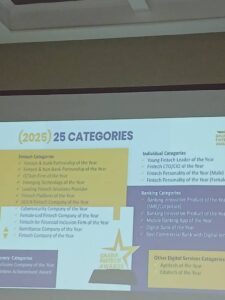
Nominations opened immediately after the launch, with the platform deliberately designed to be restrictive and secure.
“We control the integrity of the data at the gate,” he stressed. “Whatever you submit goes directly to KPMG. It is uncompromised from end to end.”
He also revealed tighter restrictions on voting:
- No votes are allowed before the official opening day.
- No votes are accepted after 11 December 2025.
- The system automatically flags irregularities.
“These checks matter because integrity is everything,” he stated.
Akpan detailed the full pipeline:
1. Nominations
The public nominates companies and individuals via a secure online portal. Only valid entries pass to the next stage.
2. Eligibility & Verification
KPMG examines every submission for:
- regulatory compliance
- category relevance
- operational legitimacy
- accuracy of data provided
3. Public Voting (20%)
Votes are counted strictly within the approved window.
“The rules ensure fairness. Popularity alone cannot win an award,” Akpan noted.
4. Jury Assessment (80%)
A panel of experts reviews evidence provided by nominees.
“We mandate that we meet the jury to understand the basis for their scoring,” he explained.
With jury scores weighted at 80%, Akpan urged companies to cooperate when asked for supporting documentation.
“The jury can only award points based on the information available to them. So when they reach out—respond.”
5. Regulatory Compliance Checks
Categories requiring licensing will demand proof—letters of no objection, certificates, and approvals.
“If your product requires regulatory oversight, we must see the approvals,” he said.
6. Final Consolidation
KPMG audits the jury scores and public votes to produce the final sealed results.
“Even the associations do not see the final winners until the Awards night,” he revealed. “That secrecy is part of the beauty and credibility of the Awards.”
Akpan reiterated the rule limiting each organisation or individual to a maximum of three categories.
“This is a competitive space. You cannot dominate the entire field,” he said.
“Selecting only three forces entities to focus on the categories where they truly excel.”
He added that the Awards Secretariat is standardising category definitions, and any new category must be justified and validated before approval.
Beyond the awards ceremony, Akpan emphasised that the underlying mission is industry growth.
“To create an enabling and resilient market, compliance is key,” he said.
“This awards process pushes the ecosystem to raise standards—operational, regulatory, and ethical.”
He ended by urging fintechs to participate actively and transparently.
“The Awards are only as strong as the information you provide. Give the jury what they need, meet the compliance checks, and let the data speak for you.”
