


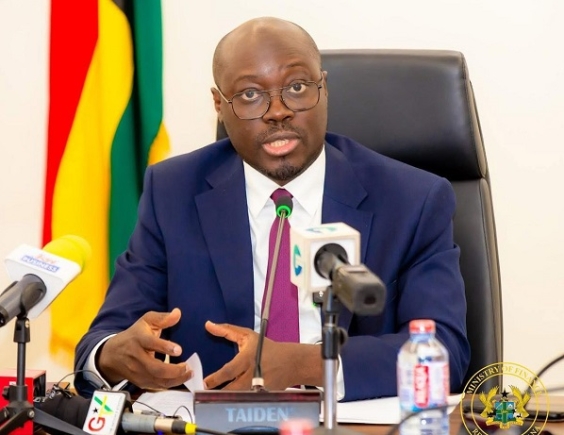
Finance Minister Hon. Dr Cassiel Ato Forson has announced one of the most ambitious agricultural transformation programmes in Ghana’s history, unveiling a sweeping plan to establish Farmer Service Centres equipped with over 4,400 mechanisation machines across 50 agricultural districts.
Presenting the 2026 Budget Statement and Economic Policy, Dr Forson declared that Ghana’s future prosperity would be grown, harvested, and processed from its own soil—and mechanisation would form the backbone of that transformation.
Dr Forson emphasised that the government’s agricultural vision is not merely about improving farming, but about building new plantations, achieving self-sufficiency in palm oil, enhancing global competitiveness, and creating 250,000 jobs across the national value chain.
To unlock this potential, he revealed that the government is securing large climate-suitable land banks through the Ministry of Lands and Natural Resources to guarantee fair compensation, secure land tenure, and full environmental compliance. He described the initiative as “a new dawn for Ghana’s agro-industrial transformation.”
Highlighting oil palm as a central pillar of the agricultural reboot, Dr Forson announced the creation of a $500 million oil palm development financing window, developed in partnership with the World Bank, development finance institutions, and the Development Bank Ghana.
He stressed that oil palm requires patience, long-term capital, and deliberate investment—not short-term borrowing. The new fund will offer:
- Long-term, low-interest financing
- A five-year grace period
- Up to 70% project cost coverage
- Support for sustainable, job-creating ventures only
Smallholder farmers, he assured Parliament, will remain “at the centre of this policy.” Through the Global Partnership Scheme, they will access improved seedlings, mechanisation, credit, and guaranteed off-take at fair prices.
Institutions including the Tree Crops Development Authority, Oil Palm Research Institute (OPRI), and Ghana Exim Bank will provide research, technical support, financing, and a smallholder support fund for women and youth.
To protect local producers, the government will introduce a tax stamp regime for edible oils to curb smuggling and stabilise the domestic market.
Together, these reforms aim to make Ghana self-sufficient, export-ready, and a regional leader in sustainable palm oil by 2032.
Dr Forson announced a historic investment in agricultural machinery, aimed at empowering farmers with modern tools for higher productivity. Under the new Farmer Service Centres, the government will roll out:
- 660 tractors
- 3,000 tractor trailers
- 200 mini tractors & matching implements
- 460 three-disc ploughs
- 204 four-disc ploughs
- 330 16-disc harrows
- 100 fertiliser spreaders
- Hundreds of precision and pneumatic seed drills
- 1,200 boom sprayers
- 50 combine harvesters
- 75 headers for harvesting maize and soy
Dr Forson said the investment was long overdue:
“Our farmers have always carried Ghana on their shoulders. With this investment, we are returning the favour—giving them the tools, technology, and support to carry the nation into a future of food security and prosperity.”
Addressing the recent nationwide food glut, Dr Forson announced that President Mahama has directed an immediate release of GH¢200 million to the National Food Buffer Stock Company to purchase and store excess food from farmers—protecting incomes and preventing post-harvest losses.
In a bold policy shift, President Mahama has also directed that all schools—from basic to SHS—must purchase only Ghana-produced rice, maize, chicken, and eggs.
Dr Forson repeated the directive for emphasis, signalling the government’s seriousness about boosting local agriculture and reducing food import dependence.
The Ministry of Education, GETFund, School Feeding Programme, Free SHS Secretariat, and the Buffer Stock Company have been ordered to ensure strict, uncompromising compliance.
Dr Forson concluded that agriculture is no longer just a sector but the engine of Ghana’s renewal.
With mechanisation, financing, land reforms, and guaranteed markets, the government believes Ghana is entering a new phase—one where every farmer becomes a driver of national prosperity and every harvest strengthens the nation’s economy.
“The transformation has begun,” he declared.
“This is not just agriculture—this is Ghana’s blueprint for industrialisation, rural upliftment, and shared prosperity.”
Click the link Puretvonline.com | WhatsApp Channel to join the WhatsApp channel
GOT A STORY?
Contact/WhatsApp: +233243201960 or manuelnkansah33@gmail.com
