

Gov’t Orders All Schools to Purchase Only Ghana-Made Rice, Maize, Chicken & Eggs — Ato Forson Announces

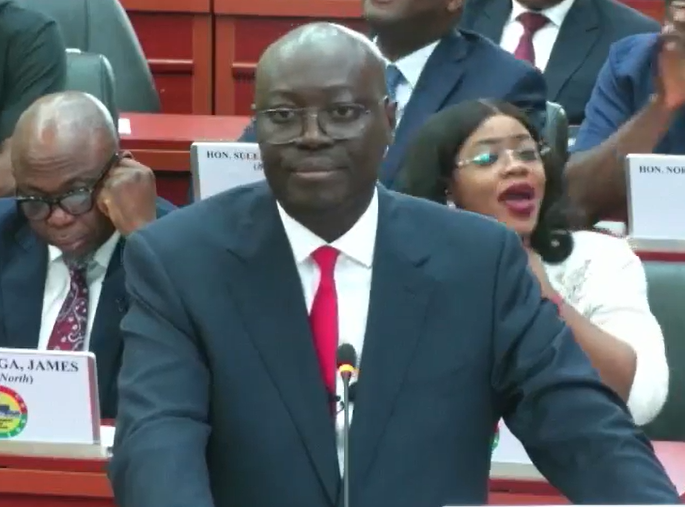
Finance Minister Dr Cassiel Ato Forson has announced a sweeping new directive that cements the central role of agriculture in Ghana’s economic future, revealing that all schools—from basic to secondary—must now purchase only locally produced rice, maize, chicken, and eggs.
Delivering the 2026 Budget Statement and Economic Policy to Parliament, Dr Forson said the policy forms part of a broader national agenda to protect farmers, deepen food security, and power Ghana’s agro-industrial transformation.
“Mr Speaker, President Mahama has directed strict compliance. Every school must buy Ghanaian produce — no exceptions,” the minister emphasised.
This directive comes at a time when the country is tackling a national food glut, and the government has already released GH¢200 million to the National Food Buffer Stock Company to absorb excess grains and poultry, safeguarding farmer incomes.
Dr Forson used the moment to draw a powerful link between the Buy-Ghana-Only school feeding directive and the government’s broader agricultural revolution — anchored by the establishment of a $500 million oil palm development financing window.
Describing the facility as a “new dawn for Ghana’s agro-industrial transformation”, the minister said the fund will support:
- Massive expansion of oil palm plantations
- Ghana’s journey toward self-sufficiency in palm oil
- Global export competitiveness
- Creation of 250,000 jobs across the value chain
“Ghana has the land, we have the people—and now, the vision—to turn every palm planted into lasting prosperity,” Dr Forson declared.
To unlock the full potential of the sector, the government will secure large climate-suitable land banks through the Ministry of Lands and Natural Resources, ensuring:
- Fair and timely compensation
- Secure land tenure for farmers and investors
- Full environmental compliance
This, the minister said, will remove one of the biggest structural barriers to plantation expansion.
The financing window — developed with the World Bank, DFIs, and the Development Bank Ghana — will provide:
- Long-term, low-interest loans
- Five-year grace periods
- Financing of up to 70% of project costs
The fund, Ato Forson stressed, is designed for “serious, sustainable, job-creating ventures”, not speculative projects.
Smallholder farmers will be at the centre of the reform, receiving:
- Improved high-yield seedlings
- Mechanisation support
- Affordable credit
- Guaranteed off-take at fair market prices
A Smallholder Support Fund will focus specifically on women and youth.
The minister further outlined a massive mechanisation push under new Farmer Service Centres, delivering 4,400 agricultural machines across 50 districts, including:
- 660 tractors
- 3,000 trailers
- 1,200 boom sprayers
- 330 disc harrows
- 460 ploughs
- 50 combine harvesters
- And dozens of precision seed drills and attachments
“Our farmers have carried Ghana on their shoulders for decades. Today, we return the favour,” Dr Forson told Parliament.
The directive requiring schools to purchase only Ghanaian-produced rice, maize, chicken, and eggs is intended to create stable demand for farmers, reduce import dependency, strengthen rural economies, and ensure money spent on feeding Ghana’s children stays within the Ghanaian economy.
Government agencies—including the Ministry of Education, GETFund, the School Feeding Programme, the Free SHS Secretariat, and the National Food Buffer Stock Company—have been ordered to ensure strict enforcement “without fail”.
Dr Ato Forson concluded that agriculture is no longer a fallback sector but the engine of Ghana’s renewal.
“Mr Speaker, the transformation has begun. Agriculture is not just an occupation — it is the foundation of our prosperity,” he said.
Click the link Puretvonline.com | WhatsApp Channel to join the WhatsApp channel
GOT A STORY?
Contact/WhatsApp: +233243201960 or manuelnkansah33@gmail.com
